Connect
Authorize the systems where work already happens: communication, documents, operations, finance, CRM, HR, data, and internal tools.
Orestal connects to the systems where your company already works, builds an evidence-backed operating model, finds high-value transformation opportunities, and helps turn selected opportunities into governed operational capabilities.
Slack, Drive, ERP, support, finance, and CRM sources
Teams, workflows, KPIs, systems, approvals, and costs
Ranked by ROI, complexity, risk, and implementation fit
Platform
The beta begins with company understanding, opportunity discovery, and implementation planning. The platform direction extends into build, deployment, and operation of the selected capabilities.
Authorize the systems where work already happens: communication, documents, operations, finance, CRM, HR, data, and internal tools.
Orestal builds a structured operating model of teams, workflows, goals, KPIs, systems, decisions, approvals, costs, and bottlenecks.
Opportunities are ranked with evidence-backed reasoning: expected ROI, implementation complexity, operational risk, and deployment fit.
Selected opportunities become implementation plans with product scope, architecture, integrations, permissions, tests, rollout, and controls.
After approval, Orestal coordinates specialist groups across product, software, DevOps, security, data, integrations, QA, and release work.
Capabilities are deployed through Orestal Cloud, customer-controlled cloud, on-premises, or hybrid paths with governed access and auditability.
Beta Boundary
The current beta focuses on understanding the company, surfacing high-value opportunities, and producing implementation plans. Build and deployment are part of the broader product direction and should remain explicitly permissioned, approved, and governed.
How It Works
Orestal moves through a controlled journey. It learns first, clarifies open ends, recommends with proof, and only builds or deploys after explicit user choice and permission.
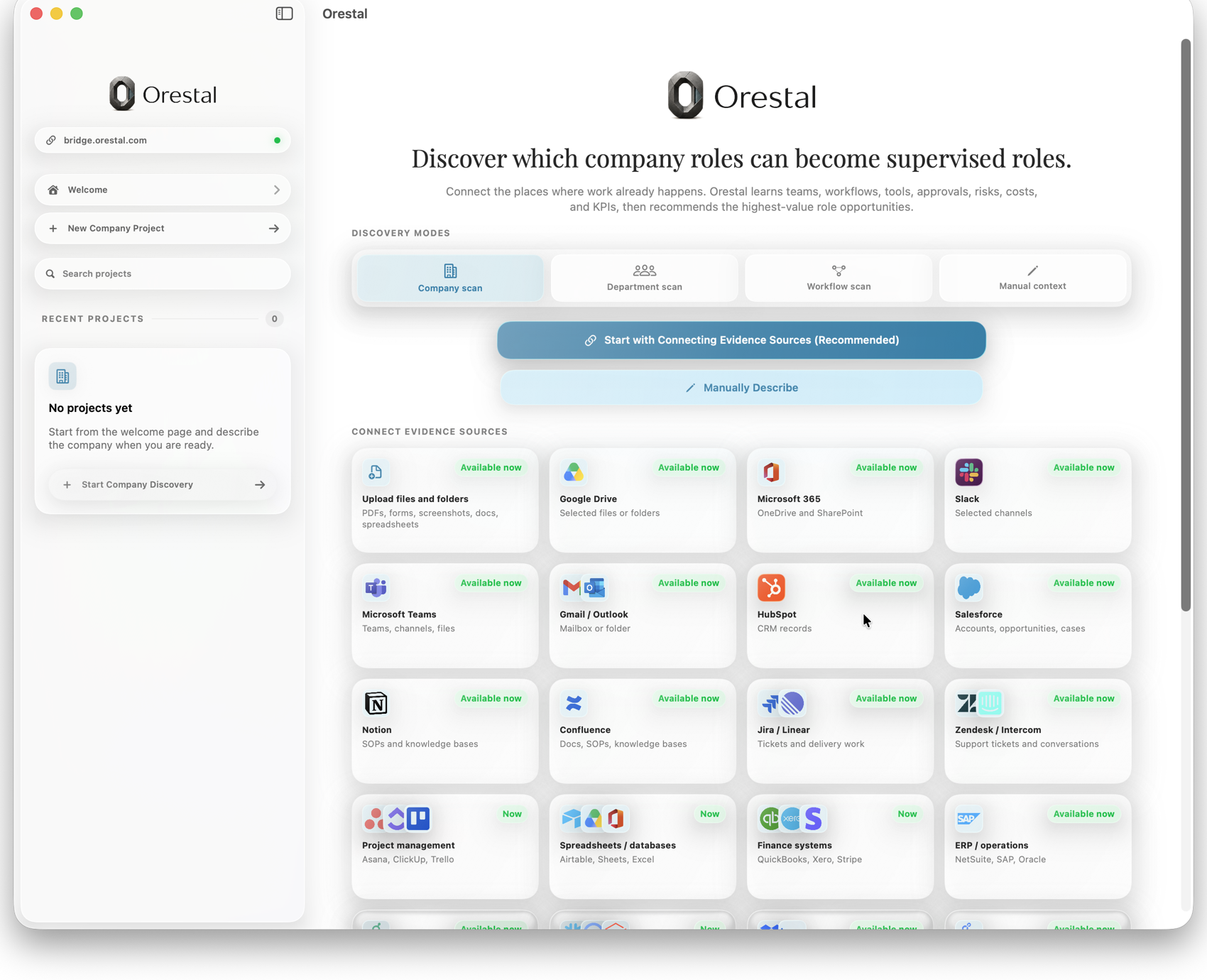
Choose the systems and context Orestal can use before it starts mapping the company.
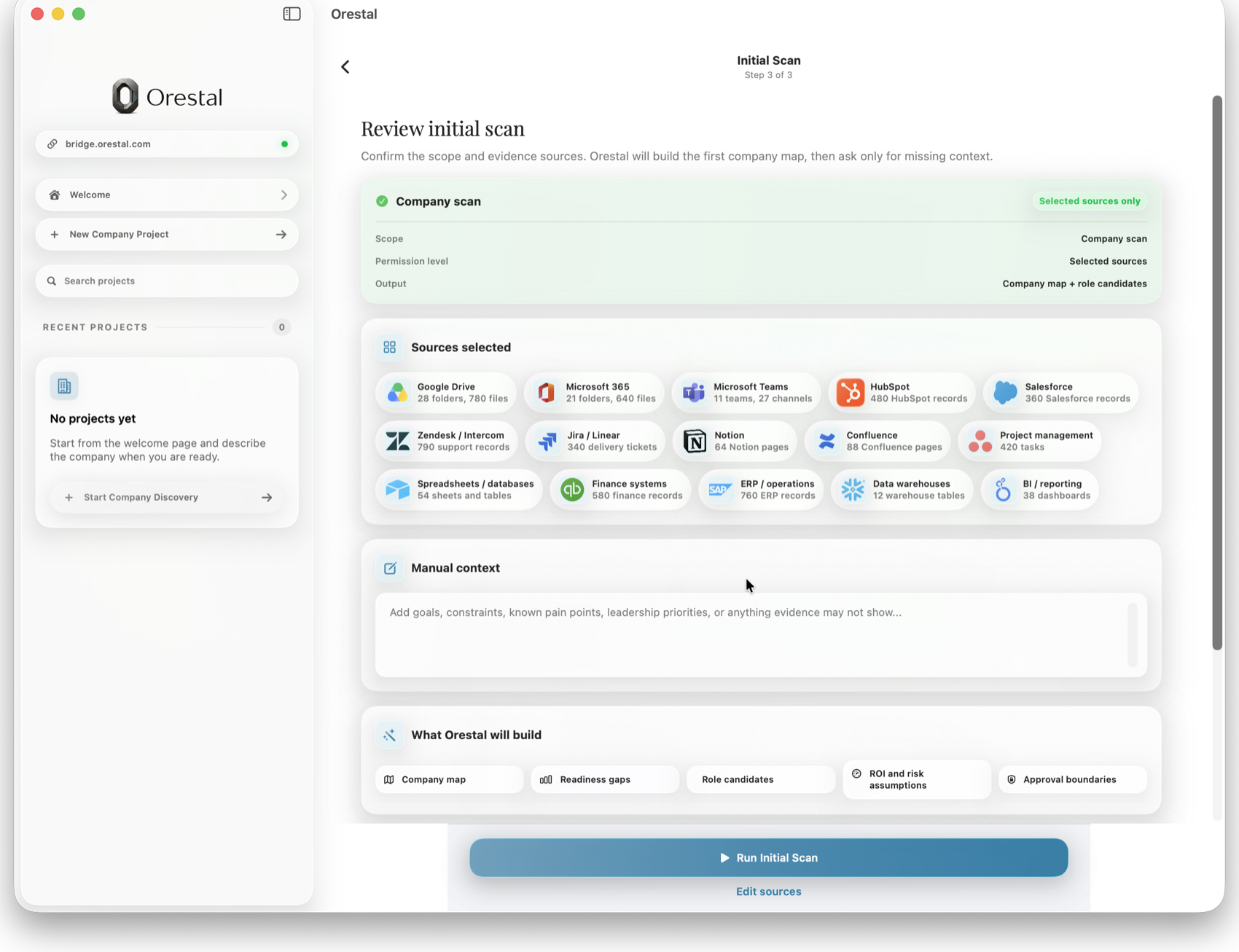
Confirm selected sources, permission level, expected outputs, and the first scan action before anything runs.
Start with scoped access to the systems that contain operational evidence. Expand only when broader access is approved.
Orestal turns scattered evidence into a live map of teams, systems, workflows, goals, KPIs, approvals, and dependencies.
When something important is unclear, Orestal asks targeted questions instead of burying assumptions inside the output.
Orestal identifies where digital roles, workflow redesign, automation, or new operational interfaces could increase efficiency.
Each opportunity explains what it solves, why it matters, which evidence supports it, what it may cost, and how ROI is estimated.
The user selects one, several, or all recommended opportunities. Orestal keeps choice and prioritization with the company.
Selected work moves into functional requirements, technical architecture, deployment options, approval gates, tests, and rollout plans.
With permission, Orestal builds the capability, deploys it through the chosen path, and hands over interfaces and controls.
Company Understanding
Orestal should understand more than tasks. It should understand the structure of the business: how teams coordinate, which systems matter, where decisions happen, what success is measured by, and which constraints cannot be ignored.
72% mapped
Delivery exception ownership is unclear when stock, credit, and transport constraints collide.
Opportunity Intelligence
Orestal evaluates where the company can move faster, reduce cost, scale better, improve consistency, or create new digital roles. Every serious recommendation should show evidence, economics, implementation path, and governance boundaries.
Coordinate sales promises, inventory constraints, transport capacity, and credit rules before customer delivery dates are committed.
Detect duplicate subscriptions, unmanaged vendor renewals, and repeated exception costs before the next close cycle.
Finance, procurement, and operations evidenceShift work based on queue health, team capacity, exception type, customer tier, and approval risk.
Support, operations, CRM, and workforce signalsUse Cases
Explore the kinds of capabilities Orestal can identify, plan, and later help build once the evidence is strong and the human boundary is explicit.
Connect sales commitments, inventory constraints, transport capacity, credit holds, and customer priority into one governed delivery decision flow.
Teams promise dates before stock, transport, finance, and exception rules are visible together.
ERP inventory, CRM commitments, transport logs, order history, credit rules, and escalation threads.
Prepare a commitment recommendation, explain constraints, and route high-risk promises for approval.
Customer-impacting delivery changes, margin exceptions, and priority overrides require owner approval before communication.
Route exceptions using team load, queue health, customer tier, approval risk, and system availability.
Identify purchase orders exposed to supplier delays and prepare customer-safe mitigation options.
Trace repeat exceptions back to upstream workflow gaps, policy conflicts, or system handoff failures.
Plan, Build, Deploy
The implementation path should include product scope, system architecture, integrations, permission requirements, security controls, test plans, rollout sequencing, and operational ownership.
Delivery Exception Control Tower
Scope: Delivery commitment decisions
Inputs: ERP inventory, CRM account tier, transport capacity
Rules: Credit holds, margin limits, approval thresholds
Integrations: ERP, CRM, ticketing, internal notifications
Tests: 180 historical exception cases
Rollout: Shadow mode -> supervised pilot -> controlled releaseOrestal's build layer should combine product planning, software engineering, DevOps, security, database, integrations, QA, and release work into a governed implementation flow.
Fastest path for teams that want Orestal-managed infrastructure, release flow, monitoring, and workspace access.
Deploy into customer-controlled cloud environments when infrastructure ownership and internal governance matter.
Support sensitive environments where data residency, local infrastructure, or strict access policies are required.
Keep sensitive systems under customer control while using Orestal-managed services for selected orchestration layers.
Security & Governance
Orestal should separate understanding, recommendation, planning, building, and deployment into clear permissioned stages. The company chooses what to connect, what to approve, and where deployed capabilities are allowed to operate.
Connectors should request only the access required for the selected company scan, plan, or deployment path.
Recommendations should stay tied to source evidence, user-provided clarification, calculations, or visible assumptions.
Customer-impacting actions, production access, deployments, and policy exceptions should require explicit approval.
The company should choose cloud, customer-controlled cloud, on-premises, or hybrid deployment based on its constraints.
Company
Orestal is built around a simple belief: serious automation cannot start from a blank prompt. It must start from the real structure of the company, the evidence behind that structure, and the human boundaries that keep change safe.
Orestal should learn from real company systems before suggesting what to change.
When the company model has gaps, Orestal should ask precise questions instead of hiding uncertainty.
The company chooses which opportunities to pursue and which deployment path fits its constraints.
Build, integration, production access, and deployment should happen only after explicit approval.

Open the beta workspace, connect selected evidence, and begin the first step toward an evidence-backed digital workforce.